Suspicious phrases in online communication that children should watch out for

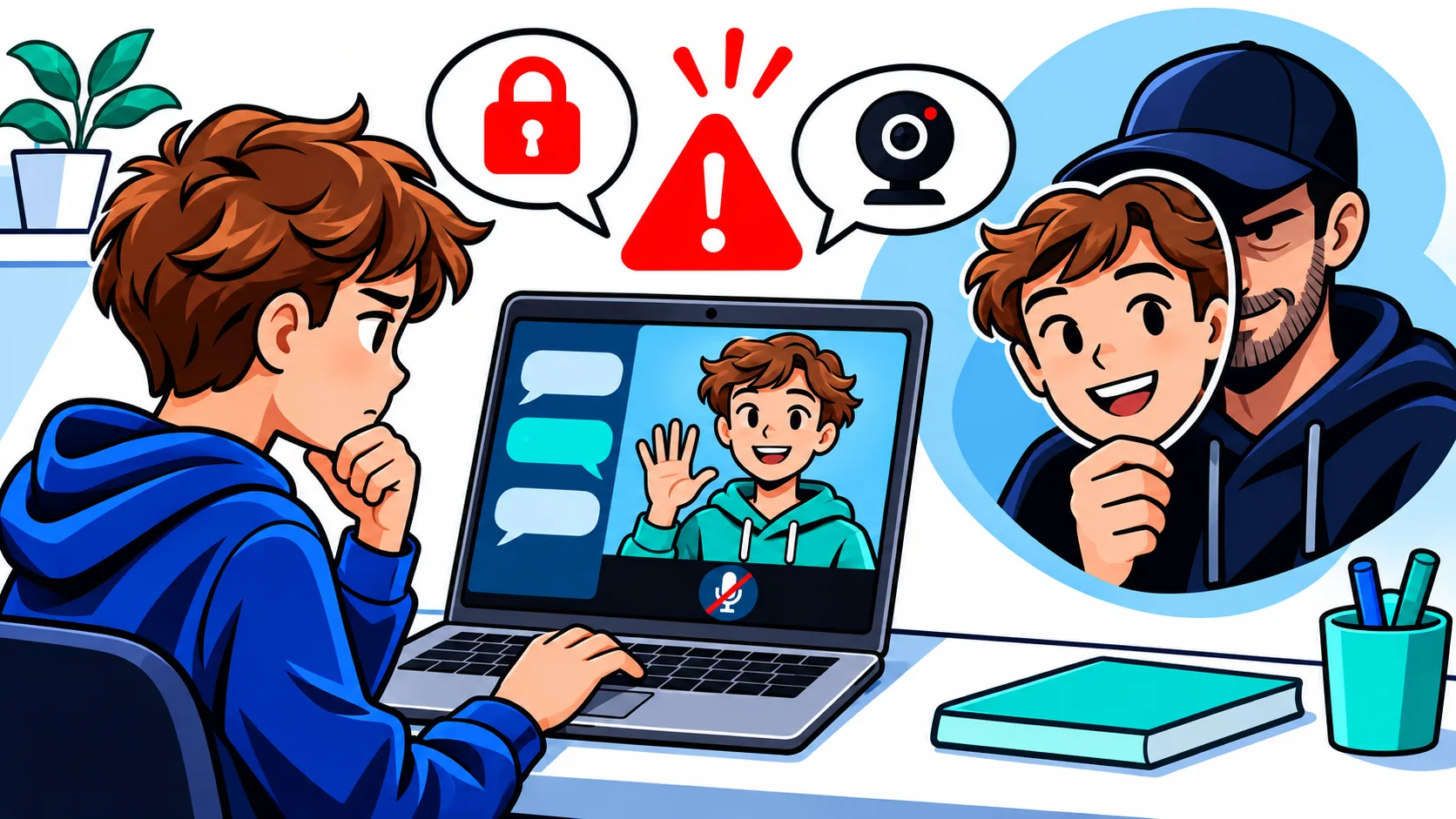
Dangerous communication on the internet can start quite innocently. Someone adds a child as a friend, shows interest in their day, and gradually wins their trust while chatting about everyday experiences. Only later do personal questions, requests to keep things secret, or pressure to turn on the camera appear. And perhaps something worse. In today’s text, we will look at several phrases that need to be watched for in communication and that children may encounter in the online world – perhaps even yours. All of the phrases come from real cases.
“Hi, I added you as a friend by mistake. I was looking for something and accidentally added you.”
An apparent mistake can serve as an excuse to make contact. The other person does not have to explain why they approached the child or where they know them from. It looks like a coincidence that could develop into a new friendship. The child may then continue talking to someone they would otherwise never have added as a friend.
A message written in the feminine gender does not prove that a girl sent it. Even the photo and age listed on the profile may not correspond to reality.
This sentence appeared in one of the cases where the perpetrator, masked behind the profile of a 13-year-old girl, sent this sentence to dozens of children and waited to see which of them would respond to his message.
“I can tell you everything, even those girly things.”
The wording itself is already a warning sign. Children do not normally use the phrase “girly things” among themselves. Such wording may reveal an adult pretending to be a girl and trying to imitate the way children communicate. At the same time, it creates the impression of an intimate friendship so that the conversation can gradually be steered toward intimate topics. The sentence alone does not prove a false identity, but it is a reason to be especially cautious.
At the same time, it may be an attempt to create an intimate atmosphere and open the door to intimate questions. A child should be particularly alert when unnatural wording is accompanied by questions about their body, sexual experiences, or requests for photos.
This phrase also comes from a real case connected with sexting and online extortion, and once again it was written by an extortionist posing as a friend from the internet.
“This will stay between us, don’t tell Mom or Dad, they wouldn’t understand.”
This is where a clear warning should ring out. The other person may be trying to prevent someone who could protect the child from finding out about the communication. They portray the parents in advance as people who do not understand the relationship, while presenting themselves as the only person who can be trusted.
The child may then feel that telling someone would mean breaking a promise or betraying a friend. Such secrecy is especially dangerous if it concerns intimate messages, photos, video calls, or a planned meeting.
By the way, this is one of the techniques that forms part of so-called manipulation within cybergrooming, specifically the technique of isolating the child from their surroundings.
“Show yourself on camera – I’ll show myself too, but my sound isn’t working. But you’ll see me, you know, I’ll wave at you.”
The promise “I’ll show myself too” can create the impression of a fair exchange. The child gets the feeling that if they can see the other person, they can safely turn on their own camera. But the image on the screen may not be a live feed of the person they are chatting with.
In the scam known as webcam trolling, the attacker may play a pre-recorded realistic video instead of their own image. The excuse that the sound is not working explains why the person in the video is not speaking. Even the wave may be part of the recording: the attacker announces it in advance and then plays the matching clip.
This scam may be followed by webcam blackmailing, that is, blackmail using a webcam recording. The attacker induces the child to engage in intimate behaviour, records it, and then threatens to publish or send the recording unless the child sends money, more material, or meets other demands. The call without sound alone is not blackmail yet, but it may be part of preparing this attack. Neither the image nor the wave by themselves reliably confirm the identity of the other person.
“If you don’t send me nudes, I’ll hurt your parents.”
This type of message is a direct form of intimidation and blackmail. The attacker tries to provoke intense fear for the life and health of the child’s loved ones, paralysing them and forcing them to act quickly without thinking. It is important to remember that such threats are often empty and the attacker relies solely on psychological pressure.
The child should not comply with such messages, send anything, and should immediately tell a trusted adult. Threatening someone is a criminal offence, and the communication must be stopped at once, evidence should be saved (screenshots), and the Police of the Czech Republic or specialist helplines should be contacted.
“Let’s move to another app, maybe WhatsApp, this one isn’t safe.”
The attempt to move communication from a more public or better moderated platform (e.g. comments on social networks, gaming chats) to a private or encrypted environment (WhatsApp, Messenger, Telegram or Snapchat) is a typical sign of online grooming (kybergrooming), sextortion and other risky phenomena. By doing so, the perpetrator tries to gain greater control over the child and create a closed, private space without the supervision of parents, moderators or other users.
Private apps with end-to-end encryption or disappearing messages (typically Snapchat) also make it easier for perpetrators to erase traces and make it harder to later prove dangerous behaviour. The excuse that the original platform “is not safe” or that “someone keeps interrupting” serves as a manipulative pretext for isolating the victim and building a more intimate relationship.
In addition to the examples above, other manipulative phrases often appear in dangerous communication:
- “Send me a photo, I won’t show it to anyone, I swear.” It creates a false sense of safety and trust. The opposite is often true.
- “If you don’t help me/send me a photo, I’ll hurt myself or harm myself.” Emotional blackmail and inducing guilt.
- “Send me a photo first so I know you’re not a fake profile.” Shifting responsibility and manipulation to obtain sensitive content.
Recommendations for parents: How to talk to children and encourage open communication
The basis of prevention is an open relationship built on trust, not on bans and punishments. Discuss the examples above with children and explain that manipulation in the online environment is often very subtle. Reassure them that they can turn to you at any time, even if they have made a mistake or sent something they regret. If children know that you will stand by them and will not immediately punish them by taking away their phone or computer, they will not be afraid to confide in you when they get into trouble.
O AUTOROVI
prof. Mgr. Kamil Kopecký, Ph.D. Vedoucí E-Bezpečí, ředitel institutu Všechny články autora → Zeptejte se